
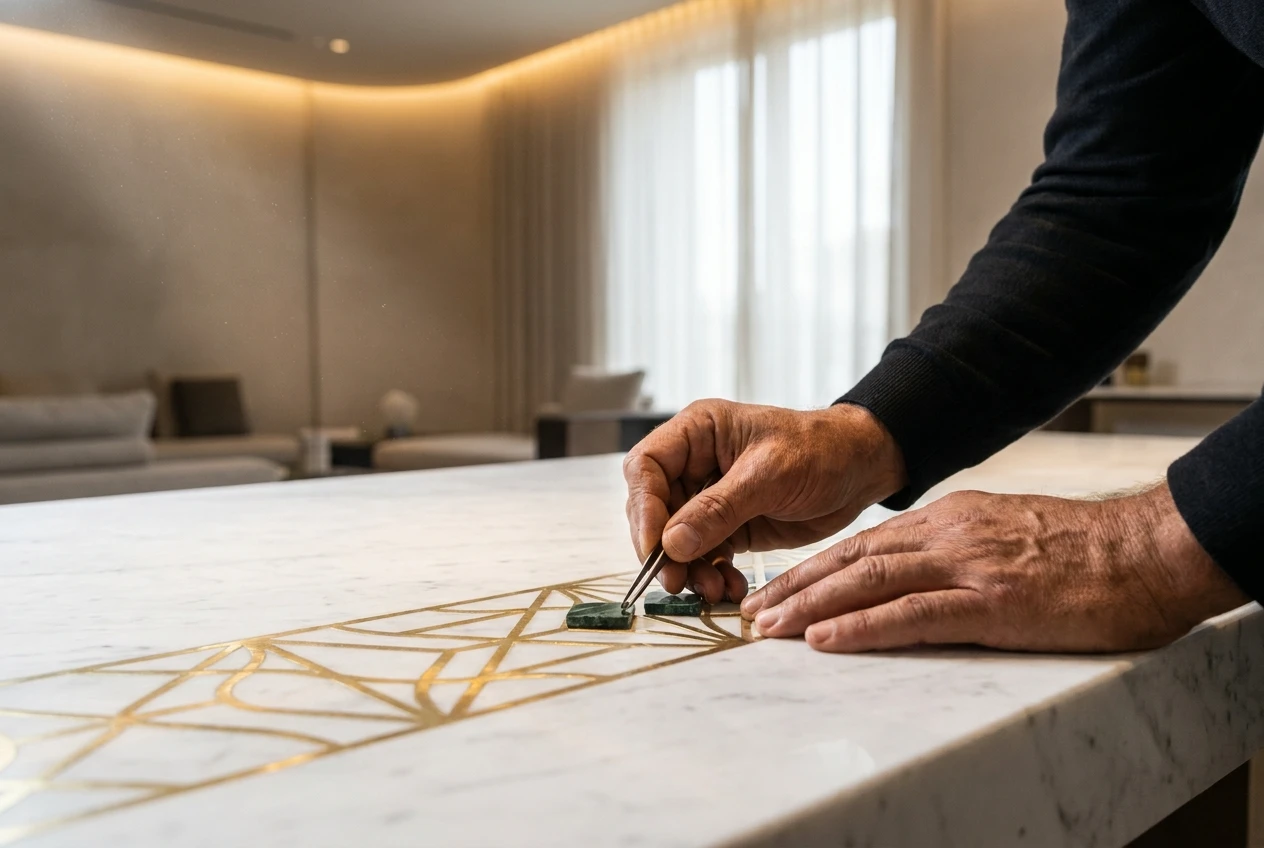
Bespoke marble inlay is a custom stone detailing technique in which precisely cut marble pieces are embedded into floors, walls, furniture, or architectural surfaces to create seamless decorative patterns. In luxury interior design, it enhances projects by adding craftsmanship, exclusivity, and spatial identity while integrating elegantly with high-end architecture and premium materials.
Why bespoke marble inlay matters in luxury interiors
In the most refined interiors, marble is not valued only for its material prestige; it is prized for the way it can be shaped into a design language. Bespoke marble inlay turns stone into composition. Instead of using marble as a broad surface finish, designers use it to draw borders, define circulation, frame focal points, and establish a sense of permanence that standard flooring cannot replicate.
This is why the technique resonates so strongly in villas, luxury residences, hotels, and other high-value projects. A custom inlay does more than decorate a space: it signals commissioning, authorship, and architectural intention. In a foyer, lobby, corridor, or dining room, it creates a distinct visual hierarchy that immediately reads as bespoke rather than specified from a catalogue.
How the craftsmanship process defines the result
The quality of bespoke marble inlay depends on precision at every stage. The process begins with design intent: geometry, motif scale, stone selection, and the way the composition will relate to surrounding architecture. Marble pieces are then cut to exact shapes and embedded into a prepared substrate, where the pattern is assembled to sit flush with the surrounding surface.
For luxury projects, the key is not ornament for its own sake. The best inlays are proportioned to the room, aligned with sightlines, and coordinated with joinery, lighting, and architectural axes. When executed well, the result is continuous and controlled rather than decorative in a superficial way.
Aesthetic advantages in high-end spaces
Visual hierarchy is one of the strongest benefits of bespoke marble inlay. It can anchor a grand entrance, emphasize a central circulation path, or create a focal field beneath a chandelier, staircase, or reception desk. In large rooms, this helps avoid visual emptiness and gives the architecture a clearer sense of proportion.
It also introduces a level of detail that feels architectural rather than ornamental. Borders, medallions, linear inserts, and geometric panels can soften the transition between stone, wood, and metal finishes while still preserving a crisp, luxurious edge. In the right composition, the inlay becomes part of the building’s visual grammar.
For clients, this matters because luxury is increasingly read through restraint and specificity. A well-placed bespoke marble inlay does not overwhelm a room; it distinguishes it.
Functional benefits beyond appearance
Although bespoke marble inlay is primarily chosen for its aesthetic value, it also supports function. In circulation areas, it can define thresholds and guide movement. In hospitality environments, it can mark zones without requiring signage or heavy visual partitioning. In residential projects, it can reinforce spatial organization in foyers, galleries, dining rooms, and stair landings.
Because the best inlays are finished flush with the surrounding surface, they can be easier to maintain than raised decorative elements. That flatness is especially relevant in high-traffic settings, where trip risk, dirt accumulation, and cleaning complexity all matter.
Material pairings that maximize impact
The most effective bespoke marble inlay schemes rely on contrast, but not conflict. Marble pairs particularly well with wood, metal, and complementary stone because each material contributes a different sensory quality.
- Wood introduces warmth and tactility, making marble feel more tailored and residential rather than monumental.
- Metal, especially bronze, brass, or darkened steel, sharpens edges and adds visual precision to borders and linework.
- Stone variations allow tone-on-tone compositions that feel subtle, monastic, and exceptionally high-end.
In a luxury residence, marble inlay paired with fine wood joinery can create a softer, more livable atmosphere. In a hotel or commercial lobby, metal accents can increase clarity and spectacle. The right pairing depends on whether the project calls for intimacy, grandeur, or brand distinction.
Customization techniques and design possibilities
Bespoke marble inlay offers considerable design freedom. Patterns may be classical, geometric, botanical, or entirely abstract. Designers can specify medallions for entry halls, borders for corridors, linear detailing for contemporary interiors, or emblematic compositions that reflect a client’s identity or property narrative.
The most compelling applications are usually site-specific. A private villa may call for a subtle border that frames a formal salon. A boutique hotel may use a recurring motif across public areas to reinforce brand recognition. A flagship residence might commission a custom motif that echoes the architecture of the staircase or the rhythm of the ceiling coffers.
For designers, this flexibility is valuable because it allows stonework to do more than decorate. It can clarify program, reinforce symmetry, and create continuity across floors, walls, and furniture surfaces.
Where bespoke marble inlay performs best
In luxury residential projects, bespoke marble inlay is especially effective in grand foyers, formal dining rooms, primary suites, stair landings, and gallery-like corridors. These are spaces where first impressions, ritual movement, and architectural refinement all matter.
In hospitality, it has strong impact in hotel lobbies, reception areas, banquet halls, lounges, and premium suites. These environments demand durability, clarity of circulation, and a memorable sense of arrival. A custom inlay can support all three while aligning with the brand’s design story.
In commercial projects, it can elevate boardrooms, private clubs, retail flagships, and executive entry areas. In each case, the design intent is similar: to create a surface that feels commissioned, not merely installed.
Cost framework and perceived value
The cost of bespoke marble inlay is shaped by design complexity, stone selection, fabrication precision, surface area, installation conditions, and the level of customization required. Because the work is highly tailored, it sits well above standard stone flooring in both material and labor intensity.
For clients, the value proposition is not only the visual result but the sense of permanence and distinction it creates. A bespoke inlay can strengthen a project’s perceived quality, support premium positioning, and contribute to the way a property is remembered. In high-end residential and hospitality environments, that impression often matters as much as the finish itself.
When presenting the concept, it helps to frame the investment in architectural terms: focal-point creation, brand expression, spatial definition, and long-term durability. Those categories speak more clearly to discerning clients than decorative language alone.
Maintenance and longevity
Marble inlay requires the same disciplined care expected of any premium natural stone surface, with attention to sealing, pH-neutral cleaning, and protection against abrasion or staining. The advantage of a flush installation is that it avoids unnecessary ridges and makes routine maintenance more straightforward.
Longevity is one of its strongest arguments. Inlay panels, borders, and medallions can remain visually relevant for decades when the stone selection, finish, and installation details are properly specified. This durability is part of the reason bespoke marble inlay is often treated as an architectural investment rather than a temporary decorative feature.
Current trends shaping bespoke marble inlay
Current luxury design trends favor personalization, material authenticity, and quieter forms of spectacle. That has strengthened interest in bespoke marble inlay, particularly where clients want depth and craftsmanship without excessive ornament.
- Minimal geometric motifs are increasingly used in contemporary residences and hospitality interiors.
- Tone-on-tone compositions create subtle luxury through texture and value variation rather than strong contrast.
- Integrated thresholds and borders help connect marble with other premium finishes across open-plan layouts.
- Identity-driven motifs are becoming more common in boutique hotels and private estates.
Another clear direction is the integration of inlay with broader architectural detailing. Instead of appearing as an isolated floor feature, it is now often designed to align with millwork, wall paneling, lighting axes, and ceiling geometry. That coordinated approach gives luxury interiors a more complete and editorial quality.
How to specify bespoke marble inlay successfully
For designers and project managers, the specification process should begin with spatial purpose. Ask where the inlay will be seen first, how it will be approached, and whether it should lead, frame, or anchor the room. Those decisions determine scale and pattern more effectively than aesthetic preference alone.
- Align the composition with major architectural axes.
- Limit material contrast when the room already has strong finishes.
- Use larger motifs in expansive spaces and finer detailing in intimate rooms.
- Coordinate stone selection with adjacent wood, metal, and wall finishes.
- Confirm maintenance expectations before finalizing the finish palette.
When these decisions are handled early, bespoke marble inlay becomes more than a surface treatment. It becomes a unifying design device that strengthens the project’s identity, supports the architecture, and communicates a level of precision that luxury clients immediately recognize.